
Olympics 2026: Some final thoughts from the bright lights of Milan
While it wasn't exactly a perfect Winter Games for Canadian skaters, they delivered some highlights worth revisiting during a riveting fortnight in Italy


So now that the Olympics hangover we’ve all been dealing with (right?) is slowly start to recede — at least that’s the sentiment here — it’s time for some sober second thoughts.
As in, the kind of thing we like to do in this space several days after a competition we were very immersed in has moved into the rear-view mirror, so to speak. The ‘so, what did it all mean’ perspective that has, quite frankly, has often been something that has been a motivator for a guy who’s always big on putting things into just the right context (or just helping others find theirs).
For the most part, what we’re about to say here is going to come across as pretty positive, and we’re not sure that’s how most folks felt about the Canadian team heading into the Milan-Cortina Winter Games. We all clung to the belief (some much more tightly than others) that ice dancers Piper Gilles and Paul Poirier had it in them to land on the Olympic podium (as it turned out, they leaped right on it), despite certain — let’s call them “winds,” although you can use another word if you like — that seemed to be conspiring against them.
It’s a safe bet that nobody expected the saga surrounding Deanna Stellato-Dudek and Maxime Deschamps would play out exactly as it did. Don’t know about you, but there was definitely a great element of surprise (that’s one way of putting it) about how the women’s event ended early and abruptly for Canada’s Maddie Schizas.
But it’s also fair to suggest that, with that lone exception — and maybe a few others — that we just mentioned, Canadian skaters turned in solid skate after solid skate in Milan (with a few spectacular ones mixed in that we’ll get around to talking about here shortly).
While there may have been some optimism about a possible medal in the Team Event, at least among the Canadians themselves, the general feeling was that it was a slim chance at best. That they didn’t get there, though, was certainly not the result of a bunch of sub-par skates. As we wrote at the time, they all gave it their best shot and it just wasn’t enough (and bravo, Italy, for stepping up the way you did).
The good news though is, thanks to Gilles and Poirier’s skate of a lifetime in the free dance, Canada got itself back on the Olympic medal train (the red maple leaf was blanked four years ago in Beijing, the first time that had happened since Lake Placid in 1980) and that’s not something that was guaranteed in the weeks leading up to the Games.
(and hey, we were so, so close to a surprise second medal)
Now, let’s dive a little deeper into some final Olympic thoughts …
A ‘Starry Night’ produces a lifetime memory
When you’ve been around this sport for as long as we have, you notice those moments that you know are going to stick with you. Those programs that, even years later, you’ll watch again and again if you get the chance. Like, for example, this unforgettable piece of magic weaved by Tessa Virtue and Scott Moir in 2018 (which has garnered a staggering 27 million views on YouTube. Lots of them mine).
You can always get me to spend a few minutes basking the spell that Kurt Browing once weaved with has classic “Casablanca” program all the way back in 1993 (still one of my all-time favourite long programs). But anyways, you get the picture.
And yes, Milan gave us another one of those moments. We speak, of course, of the marvellous rendition of “Vincent (Starry, Starry Night)” that Piper Gilles and Paul Poirier performed on an unforgettable Wednesday night at Milano Ice Skating Arena. It was literally the skate of their lives and what a stage on which to do it.
While the medal it earned was bronze, it had to have felt like gold to Gilles and Poirier, who were undoubtedly the most joyous team on the ice dance podium that night (have a look if you don’t believe me). But it was the performance that led to that moment that’ll stick with me for a very long time. It was absolute perfection when this Canadian duo needed it but more than that was the connection it created.
It was emotional, it was riveting, and it had many in the arena weeping by the end of it all (and probably more than a few of us back at home). This was an Olympic moment by every definition, and it’s very fair to suggest that Gilles and Poirier were the people’s champions on this night. As we wrote on the night it happened, this was surely one of the most popular medals earned by any Canadian at these Games.
What added to this entire story was the sometimes treacherous road Gilles and Poirier had to take to get to that podium. We speak mainly about the judging nonsense they dealt with at both Finlandia Trophy, which surely planted seeds of doubt in their minds that perhaps they weren’t going to be allowed to achieve that Olympic dream.
Much of that was laid out in the Netflix series “Glitter & Gold: Ice Dancing,” which was released in the days before the Opening Ceremony at the Games. We’re of the opinion that the series painted Gilles and Poirier as two skaters battling against the system, and it made them sympathetic but scrappy underdogs in Milan.
(it also did wonders for the readership of this column).
For those of us who have followed their story since they first joined forces as teenagers way back in 2011, this was the chapter we wanted to see written at these Winter Games. Only three ice dance teams from Canada have ever landed on an Olympic podium, and Gilles and Poirier surely deserved to join that exclusive group. That they did it with the performance of a lifetime … that’s some true Olympic magic.
Meet the next big star of Canadian skating
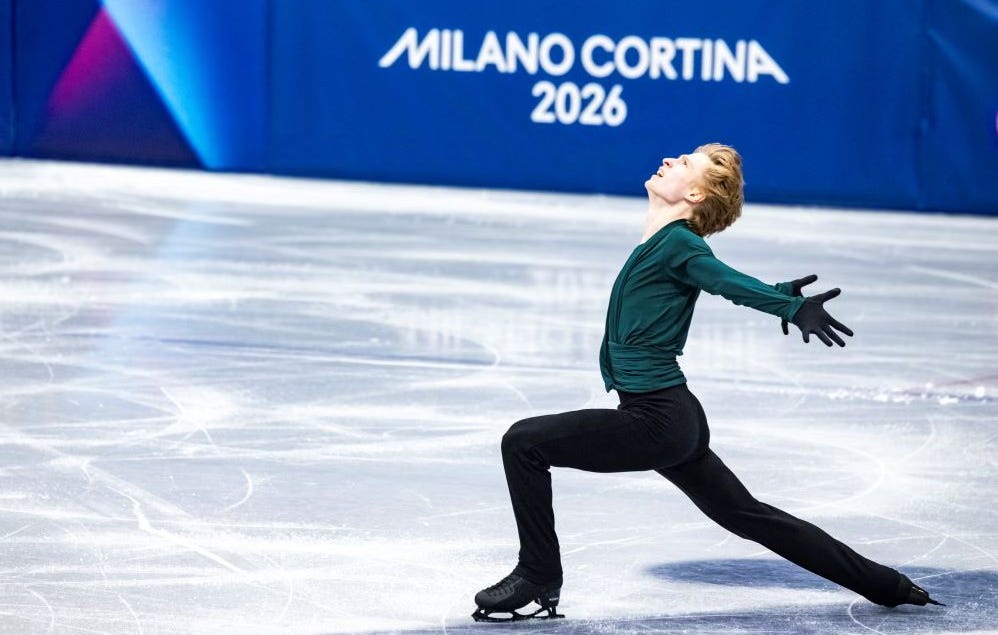
Found it amusing to read early in the Games that there was a lot of “who is this guy” talk floating around Milan after Stephen Gogolev laid down a fabulous short program that kept Canada, at the time, in the hunt for a Team Event medal.
Let’s just say a whole lot of folks know who he is now.
As the lone Canadian man at the Olympics, the 21-year-old Gogolev had to skate four times in less than a week. And quite frankly, we couldn’t have asked for much more from him in his Winter Games debut. He was a standout in the Team Event, then raised the bar even higher with the free skate of his life in the men’s competition.
That massive personal best score (186.37) — the second-best free skate of the night, only behind Olympic champion Mikhail Shaidorov — launched him up to fifth place in the final standings (the highest finish by a Canadian man at the Olympics since Patrick Chan’s silver medal in Sochi in 2014). Not only that, he was just a mere 1.12 points away from a medal in his Games debut.
It was an exclamation point on a season that, as we detailed here, has done nothing but progress upward since the fall. And surely, what happened in Milan has to have him primed and motivated to show even more at the World Championships later this month, where he could (and should) be seen as at least a fringe medal contender.
As someone who knows his journey all too well — from 13-year-old prodigy who won the Junior Grand Prix Final, all the way through to the seemingly endless back issues that had him off the ice just a year ago and on the verge of quitting the sport — this truly rates as one of the best stories in Canadian skating this season.
The even more exciting part is that he is still just getting started, and we can only imagine where Gogolev can take things between now and the 2030 Winter Olympics in France. And oh yes, everyone is going to know his name over the next four years. Count on that.
The pairs torch has officially been passed
Way back in January, we were standing just mere feet away from Lia Pereira and Trennt Michaud when they learned they’d became Canadian pairs champions for the first time. It was one of those true breakthrough moments, which ended the three-year national title run of an ailing Deanna Stellato-Dudek and Maxime Deschamps.
Turns out that was just the springboard Pereira and Michaud needed heading into their first Winter Olympics, which ended up being a slightly busier time than either imagined. When Stellato-Dudek’s injury a week before the Games forced her and Deschamps to bow out of the Team Event (they were supposed to skate the short program), it put everything on Pereira and Michaud’s backs.
The first-time Olympians performed admirably in that scenario, with a pair of strong skates. Then they did themselves on better, turning in a personal best score of 74.60 in the pairs event short program, which was good enough for a third place and a shot at a medal. While they faded to eighth in the final standings, it was three spots better than Stellato-Dudek and Deschamps, who essentially scuttled their chances with an untimely fall in the short.
With Stellato-Dudek and Deschamps pulling out of Worlds, it’s another chance for Pereira and Michaud to take the lead position in Canadian pairs. While they haven’t officially declared any plans for the next quadrennial — Milan was the target from the day their partnership was first formed back in 2022 — it’s not hard to see these two sticking around for another four years (at 21 and 29, they’re still relatively young in pair terms).
And no matter what happens later this month in Prague, they will carry a tremendous amount of momentum and confidence into whatever comes next. It’s been a landmark year for them, indeed.
A not so roaring finish for the Canadian lion
For half a season, there seemed to be — at least among some folks — an element of intrigue (doubt?) about which Canadian woman would make the cut to be the country’s lone representative at the Winter Games. Then Maddie Schizas made her audacious declaration in Gatineau and backed it up by winning a fourth Canadian women’s title.
It seemed her skating was in just right place, then, heading into the Olympics. She acquitted herself well in the Team Event — perhaps not quite at the same level as four years ago in Beijing, when she was star of the show for Canada in that event — but good enough to have her in the right frame of mind heading into the women’s competition a little more than a week later. Or so it may have appeared.
All of which made what happened in the short program an abject, rather shocking disaster. It all came down to a triple loop that was doubled, making it an invalid element. That was a huge enough error to dump Schizas all the way down to 25th place, where she agonizingly missed advancing to the free skate by less than a point (it’s the first time Canada hasn’t had a participant in an Olympic women’s free program since Nagano in 1998).
And sadly, that is going to stand as her final skating moment at the Olympic Games. It is hard to even imagine her being in France in 2030 — whether she continues past this season is certainly up for debate, especially given her ambitions in the classroom (she’ll complete an undergrad degree in Environment and Society at McMaster University in the spring, but is likely not done with school yet).
She’ll have a chance for some redemption later this month at Worlds and we’re thinking “feisty Maddie” is going to show up in Prague wanting to leave a much better final statement to her season. We’re not even going to get into top 10s or anything like that. This will just be about laying down the best skates possible and see where the cards fall.
It says here that the work Schizas has done for Canadian women’s skating since Beijing has been perhaps a little under-appreciated. Over the past four years, she’s been the one being tasked with going to Worlds every time, in search of that elusive top-10 finish that would open up the door for a second Canadian woman.
She came close twice, never more so than last year in Boston, when she placed 11th. And those four Canadian titles she earned? Only a handful of Canadian women ever have matched or surpassed that. As the kids like to say these days, that’s not nothing.
Who will lead Canada into a new quadrennial?
We all know there are going to be a slew of retirements around the figure skating world in the months to come, as is custom following a Winter Olympics. And soon enough, we’ll start to see a new generation emerge as the leaders of the sport on the road to 2030.
In Canada, we can already see who some of those individuals will be. Gogolev is going to be the clear standard bearer among Canadian men, with some exciting young talents (Grayson Long and David Bondar, to name just two) eager to follow in his wake.
We’ve already mentioned Pereira and Michaud as the pairs frontrunners, and we saw a glimpse of some of the new generation at nationals in Gatineau, where Ava Kemp and Yohnatan Elizarov placed fourth in their senior debut. Pairs has been Canada’s strongest discipline internationally at the junior level over the past two or three years, so there’s even more to come.
With the expected retirement of Gilles and Poirier, it will finally be time for Marjorie Lajoie and Zachary Lagha to lead the way in ice dance (Canada’s historically strongest discipline for at least two decades now). And there should be plenty of depth behind them, especially if Marie-Jade Lauriault/Romain Le Gac and Alicia Fabbri/Paul Ayer both choose to continue.
As for the women … that’s the wild card right now. If you’re looking at the full quad, a name to watch will surely be Minsol Kwon, the South Korean who placed third in her debut at a Canadian championships. The belief here is we could see her skating internationally for Canada as soon as this fall (at nationals, Kwon expressed her desire to take part in the Junior Grand Prix for the red maple leaf), and she’d have plenty of time to gain the citizenship she needs to represent her adopted country at the 2030 Games.
Of course, we all can’t wait to see what the immensely talented Lia Cho can do when she eventually reaches the senior ranks. But as things now stand, she won’t be age eligible for the next Olympics (she misses the cutoff by a matter of weeks) — even if she could well be the Canadian senior women’s champion by then.
No doubt other names beyond the ones listed about will emerge over the next quadrennial, and that’ll give us even more to track. As always, it’ll be fun seeing just where all this leads in the years ahead.
Canada sets its Worlds team
Skate Canada chose to wait until after the Olympics to name its team for the World Figure Skating Championships, which will run from March 25-28 in Prague. It’ll mark a return of this competition to the Czechia capital for the first time since 1993 (Worlds were also held there in 1962. Canadian skaters won two golds on each occasion).
The Canadian team headed to Prague is essentially the same one we saw in Milan, with one major exception — Deanna Stellato-Dudek and Maxime Deschamps, the 2024 World champions, have chosen to take a pass on the event (it’s something they hinted might be a possibility after their free skate in Milan, where they placed 11th).
Taking their place on the Canadian team are Kelly Ann Laurin and Loucas Ethier, who will now make their third straight appearance at Worlds (they were 15th and 16th the previous two years). It’s also a nice reward for a team that has done its best skating during the back half of the season and impressed in placing third at nationals.
Here’s the full team that will carry Canadian colours in Prague:
Men: Stephen Gogolev
Women: Maddie Schizas
Pairs: Lia Pereira/Trennt Michaud; Kelly Ann Laurin/Loucas Éthier
Ice Dance: Piper Gilles/Paul Poirier; Marjorie Lajoie/Zachary Lagha; Marie-Jade Lauriault/Romain Le Gac
Juniors take the spotlight
The World Junior Figure Skating Championships begin next Wednesday in Tallinn, Estonia, and run through to Saturday. The Canadian team at this event matches the size of the one being sent to Prague, with pairs being the one discipline with three entries in this case (it’s also where the biggest medal hope resides).
Here’s who will be wearing the red maple leaf in Tallinn:
Women: Megan Woodley
Men: David Bondar
Pairs: Jazmine Desrochers/Kieran Thrasher; Ava Kemp/Yohnatan Elizarov; Julia Quattrocchi/Étienne Lacasse
Ice Dance: Summer Homick/Nicholas Buelow; Layla Veillon/Alexander Brandys
(Bondar is a late replacement for Grayson Long, who was forced to pull out of Junior Worlds because of an injury suffered in practice).
The ISU’s YouTube channel will be the place to watch all of the action, with the schedule as follows (all times ET):
March 4: Pairs short, 5:15 a.m.; Men’s short, 9 a.m.
March 5: Women’s short, 3:40 a.m.; Pairs free, noon
March 6: Ice dance rhythm dance, 6 a.m.; Men’s free, 11:15 a.m.
March 7: Ice dance free dance, 4:30 a.m.; Women’s free, 8:30 a.m.